Wheels of Wonder: The 10 Most Jaw-Dropping Concept Cars of the Last Decade — And What They Mean for Your Connected Drive
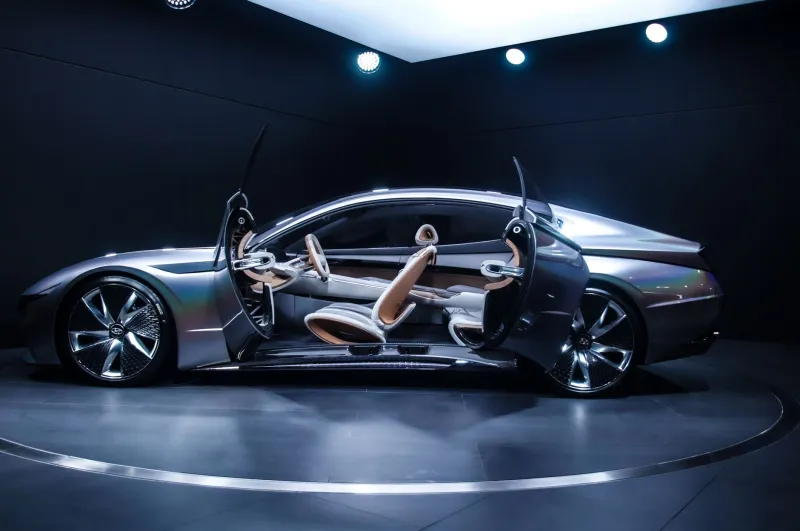
Concept cars used to be about wild styling and impossible doors. Designers would sketch something outrageous, wheel it out at Geneva or Frankfurt, everyone would gasp, and then it would quietly disappear into a museum basement. Job done.
But something shifted over the last decade. The concept car became a technology showcase — a place where automakers battle phone manufacturers, network operators, and Silicon Valley giants for control of the dashboard. Suddenly, the most interesting thing about a concept isn't the bodywork. It's the SIM card inside it.
Here's our pick of the ten most breathtaking concept cars of the last ten years, with a particular eye on what they mean for the connected, mobile-first future of driving.
1. Mercedes-Benz Vision AVTR (2020)
Inspired by the film Avatar (yes, really), the AVTR is arguably the most visually arresting concept of the entire decade. No steering wheel. No conventional controls. You place your hand on a central console and the car reads your biometrics. The 33 moving "bionic flaps" on the rear respond to your commands like something from a fever dream.
For tech fans, the real story is the seamless human-machine interface — the kind of integration that requires ultra-low-latency 5G connectivity to function in the real world. Mercedes isn't shy about the fact that making this work on public roads depends entirely on network infrastructure the UK is still building.
2. BMW i Vision Circular (2021)
BMW's circular economy concept is made almost entirely from recycled materials, but the tech story is just as compelling. The i Vision Circular features a fully digital interior with no physical controls whatsoever — everything is managed through gesture, voice, and a connected smartphone ecosystem. It's essentially a four-wheeled extension of your handset.
In practice, that means your phone becomes your key, your wallet, your entertainment hub, and your navigation system all at once. Great in theory. Less great when you're on the M6 and your network drops to a single bar.
3. Rolls-Royce 103EX (2016)
Slightly outside the strict decade window but impossible to leave out, the 103EX — officially the Vision Next 100 — is a masterclass in restrained futurism. Silk interior, a personal AI called Eleanor, and a level of autonomous driving ambition that still feels years away.
The 103EX imagines a world where your car knows your schedule better than you do, communicating constantly with cloud services via embedded connectivity. For UK drivers, it's a reminder of just how dependent the autonomous future is on reliable mobile infrastructure — something that remains patchy outside major cities.
4. Volkswagen ID.Space Vizzion (2019)
VW's sleek estate concept previewed the ID family's connected future with a minimalist interior dominated by a vast touchscreen and an augmented reality head-up display that overlays navigation data directly onto the road ahead. The AR system requires real-time data streaming — and yes, that means network coverage matters enormously.
VW has been quietly working with mobile operators across Europe to ensure its production EVs maintain reliable connectivity. The Space Vizzion was the concept that made those conversations urgent.
5. Sony Vision-S 01 (2020)
When a television manufacturer turns up at CES with a concept car, you pay attention. Sony's Vision-S bristles with 33 sensors, a 360 Reality Audio sound system, and a cabin designed around the idea that passengers — not just drivers — deserve an immersive connected experience.
Sony subsequently launched a joint venture with Honda, which says everything about how seriously consumer electronics brands are taking the automotive space. Your next car might effectively be a Sony smartphone on wheels.
6. Citroën Oli (2022)
A refreshingly different entry on this list. The Oli (pronounced "olly") is Citroën's vision of sustainable, lightweight motoring — and it's genuinely radical precisely because of what it doesn't have. No vast touchscreen. Physical controls. A top speed capped at 68mph to maximise range.
For a tech audience, the Oli is a provocation: in a world obsessed with connectivity and screens, is simpler actually smarter? It's the concept car equivalent of buying a dumb phone to escape notification overload.
7. Audi Skysphere (2021)
Audi's Skysphere is a shape-shifting roadster — the wheelbase literally extends or contracts depending on whether you're driving manually or letting the autonomous systems take over. It's theatrical engineering, but the underlying tech is serious: a fully connected architecture that communicates with infrastructure, other vehicles, and cloud services simultaneously.
For UK drivers, the V2X (vehicle-to-everything) communication the Skysphere relies on requires dedicated network spectrum. Ofcom has been consulting on this for years. Progress has been... measured.
8. Renault 4ever Trophy (2022)
Renault's reimagining of the iconic 4L as a rugged electric off-roader was one of the most charming concepts of recent years. But beneath the retro styling sits a thoroughly modern connected platform, with over-the-air updates, integrated mapping, and a digital cockpit designed around smartphone mirroring.
It also previewed the production Renault 4 E-Tech, which arrives in the UK in 2025 — proof that concept cars are increasingly direct previews of what you'll actually be able to buy.
9. Hyundai Seven (2021)
Hyundai's Seven concept reimagines the SUV as a lounge on wheels — a space where you relax, work, or socialise while autonomous systems handle the driving. The interior features a sliding centre console, a proper table, and ambient lighting that responds to your mood.
The Seven assumes that reliable, high-speed connectivity is simply always available. In central London, maybe. In rural Wales, almost certainly not. It's a recurring theme across this list: concept cars are designed for a network Britain hasn't fully built yet.
10. Apple Car (Various Leaks, 2014–2024)
OK, so Apple never officially revealed a concept car — Project Titan was cancelled in early 2024 after a decade of rumours, leaks, and billions spent. But the idea of an Apple Car was so influential that it deserves a place on any list of defining automotive concepts of the decade.
Apple's reported vision — a fully autonomous vehicle with no steering wheel, deeply integrated with iPhone and the broader Apple ecosystem — pushed every other manufacturer to think harder about software, connectivity, and user experience. Even in death, Project Titan shaped the cars on this list.
What Does All This Mean for UK Drivers?
The through-line connecting all ten of these concepts is connectivity. Whether it's biometric interfaces, over-the-air updates, autonomous navigation, or V2X communication, every vision of the future car depends on fast, reliable, ubiquitous mobile network coverage.
The UK's 5G rollout is progressing, but coverage remains uneven. Urban cores are well served; rural and suburban areas less so. The cars of the future are being designed for a network that, in many parts of Britain, simply doesn't exist yet.
That gap between concept and reality is worth keeping in mind next time you marvel at a stunning design on a motor show stand. The bodywork is the easy part. Sorting out the signal is considerably harder.
For now, these ten concepts remain exactly that — concepts. But they're the clearest window we have into where driving, technology, and connectivity are heading. And as Phone Week readers know better than most, the network underneath it all is what makes or breaks the experience.